
Human Immune System Mice
- Products
- Animal Models
- Human Immune System Mice
- huHSC-NCG-hIL15

huHSC-NCG-hIL15
Type : CD34+ Humanized Mice
Strain Number : T038070
Background Strain: NCG-hIL15 [T004886]
HuHSC-NCG-hIL15 Mice are NCG-hIL15 [T004886] mice engrafted with cord blood human CD34⁺ hematopoietic stem cells (CD34+ HSC). This strain is genetically modified to express human interleukin-15 (hIL-15), a cytokine essential for the development, survival, and activation of natural killer (NK) cells and memory CD8⁺ T cells. Following transplantation with human CD34⁺ HSC, the huHSC-NCG-hIL15 mice support robust engraftment, expansion differentiation and persistence of functional NK cells.
Features of HuHSC-NCG
1.Functional human Immune cell subsets (T, B and myeloid) with enhanced NK cell development and function.
2.Minimal 20% hCD45 in peripheral blood
3.Stable engraftment and long Lifespan > 39 weeks
4.Customizable :
- huHSC-NCG-hIL15 for NK-T interaction and NK cell-mediated antibody-dependent cellular cytotoxicity (ADCC) assessment
- huHSC-NCG-M for T-cell and Myeloid dependent Efficacy studies
- HLA partially matching for cells and tissue transplantation

Oncology and Immuno-oncology e.g : ADCC, Car-NK

Immunology & Inflammation

Infectious Diseases

Autoimmune Diseases
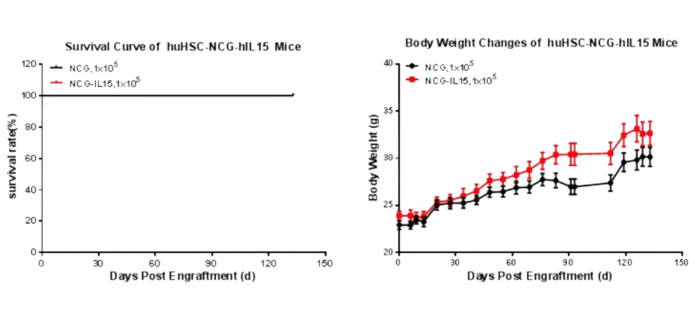
Fig 1: Survival and weight changes in mice post CD34+ HSC engraftment
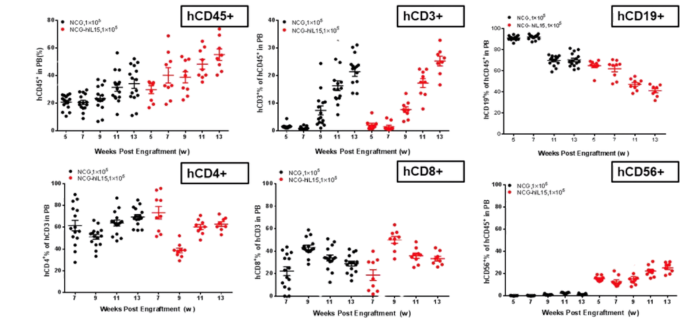
Fig 2: Immune cell reconstitution in peripheral blood of huHSC-NCG and huHSC-NCG-hIL15 mice.
Peripheral blood was collected at weeks 7, 9, 11, and 13 post-engraftment and analyzed by flow cytometry to assess immune cell development in huHSC-NCG and huHSC-NCG-hIL15 mice.
- Shultz et al. (2005). Human Lymphoid and Myeloid Cell Development in NOD/LtSz-scid IL2Rγnull Mice Engrafted with Mobilized Human Hemopoietic Stem Cells. J Immunol, 174(10): 6477–6489.
- Seitz (2010). Establishment of a Rhabdomyosarcoma Xenograft Model in Human-Adapted Mice. Oncology Reports.
- Wege et al. (2011). Humanized Tumor Mice: A New Model to Study and Manipulate the Immune Response in Advanced Cancer Therapy. Int J Cancer, 129(9): 2194–2206.
- Ali et al. (2015). IL-15–PI3K–AKT–mTOR: A Critical Pathway in the Life Journey of Natural Killer Cells. Front Immunol, 6:355.
- Fehniger et al. (2001). Fatal Leukemia in Interleukin-15 Transgenic Mice Follows Early Expansions in Natural Killer and Memory Phenotype CD8⁺ T Cells. J Exp Med, 193: 219–231.

Axiocell Biotech Sdn Bhd.
Suite 2-5, Level 18, Plaza Azalea 10, Persiaran Bandaraya, Seksyen 14, 40000 Shah Alam, Selangor.
© 2025 AXIOCELL BIOTECH. All rights reserved.
Developed by Infinicore – Design by LeMoon