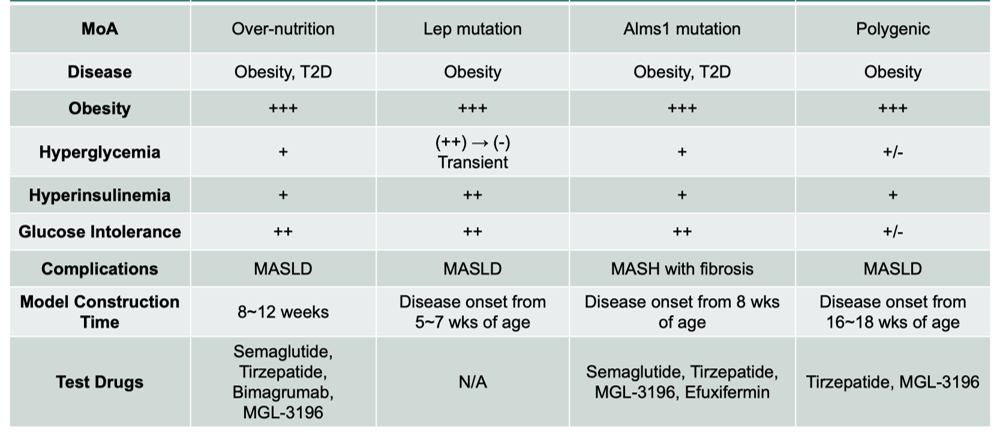
Metabolic disorders such as obesity and diabetes are global health challenges with rising prevalence and significant clinical burden. To better understand the underlying mechanisms and develop effective therapies, preclinical models that accurately mimic human disease are essential.
Rat and mouse models of obesity and diabetes are widely used due to their genetic tractability, reproducibility, and physiological relevance. At Axiocell, we provide a comprehensive portfolio of mouse and rat models using genetic, diet-induced, and chemically induced methods.
These models are validated and optimized for studies in:
Pathogenesis of metabolic disease
Drug screening and efficacy
Anti-diabetic and anti-obesity therapeutics
Combination therapy and lifestyle intervention studies
Commonly Used Obesity Models
Type 2 Diabetes (T2D); Metabolic dysfunction-associated steatotic liver disease (MASLD)
Desciption: In C57BL/6JGpt mice, knocking out the Leptin gene causes severe morbid obesity, temporary blood glucose elevation, compensatory expansion of the islets of the Langerhans, and severe insulin resistance, with mild complications.
Desciption: An 11-bp base deletion in exon 8 of the Alms1 gene in C57BL/6JGpt mice led to early termination of translation of the Alms1 gene, leading to a combined phenotype of obesity, early diabetes and metabolic dysfunction-associated steatotic liver disease. These mice are ideal models for studies on obesity and fatty liver.
Desciption: Moderate obesity and mild insulin resistance are induced with a 60% high-fat diet in C57BL/6JGpt mice. These mice are applicable to studies on obesity and obesity-related complications.
Desciption: After 8 weeks of age, D000750 mice develop spontaneous obesity with significantly elevated cholesterol levels and mildly elevated blood glucose levels. These mice can develop a fatty liver phenotype with age and are applicable to studies on fatty liver disease, hyperlipidemia, cardiovascular disease, and obesity. Western diet (WD) induction accelerates the appearance of MASH symptoms.
To learn more about custom studies or model development tailored to your research needs.
Case Study - Drug efficacy of MGL-3196 and Semaglutide on DIO mice.
Body Weight
Figure 1. Semaglutide and MGL-3196 combination treatment enhances body weight loss in B6 DIO mice. Data are presented as Mean±SEM
Food Intake
Figure 2. MGL-3196 does not affect food intake of DIO mice. Data are presented as Mean±SEM.
Fat Mass Changes
Figure 3. Combination treatment of MGL-3196 and Semaglutide significantly increases the reduction of fat mass in DIO mice while preserving lean mass. Data are presented as Mean±SEM. ns, not significant; **, p<0.01; ****, p<0.0001 by one way ANONA.
Energy Expenditure
Figure 4. MGL-3196 enhances energy expenditure in DIO mice. Data are presented as Mean±SEM. ns, not significant; **, p<0.01; ****, p<0.0001 by one way ANONA.